


What Is a Good Rental Yield in the UK in 2026?
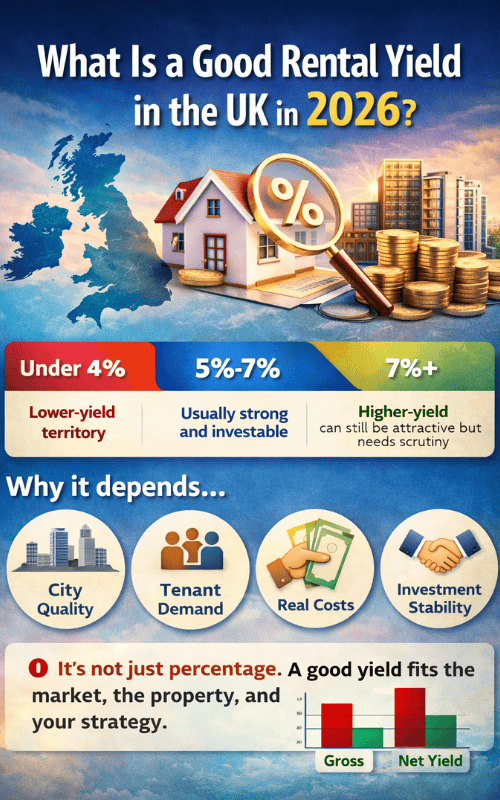
A good rental yield in the UK in 2026 is usually somewhere in the 5% to 7% range, depending on the city, the property type, and the real costs involved. That said, there is no magic number. A yield that looks strong on paper can still be a poor investment if tenant demand is weak, costs are high, or the area lacks long-term appeal. And a lower-looking yield can still be a smart buy if the city is stronger, the property is easier to let, and the overall investment is more stable. In other words, good yield is not just about the percentage. It is about how sustainable that percentage really is.
Quick Answer: What Counts as a Good Rental Yield?
Under 4% → often lower-yield territory
5% to 7% → usually strong and investable
7%+ → can be attractive, but needs closer scrutiny
Net yield matters more than gross yield
That is the short answer.
And for most investors, it is the right starting point.
If you are looking at a deal and asking, “Does this actually stack up?”, the first thing to understand is that yield only becomes useful when it is placed in context. A 6% yield in a strong city with broad tenant demand can be far more attractive than an 8% yield in a weaker area with more letting risk.
If you want a wider benchmark first, Aspen Woolf’s UK Rental Yields 2025 – Where to Find the Best Buy-to-Let Returns and Average Return on Property Investment UK are useful places to compare broader return expectations.
Why There Is No One Perfect Number
This is where many first-time investors get stuck.
They want one clean answer.
One number.
One benchmark that tells them whether a property is good or bad.
But rental yield does not work like that.
It depends on:
- the city
- the area within the city
- the type of property
- the quality of tenant demand
- the costs attached to the unit
- whether you care more about income or long-term growth
A city-centre apartment in a stronger market may show a lower headline yield than a cheaper unit in a weaker area. But that lower-yield asset might still be the better investment if it is easier to let, easier to manage, and easier to sell later.
That is why investors should be careful with the phrase “high yield property UK”.
High yield is not always the same as high quality.
Sometimes it is.
Sometimes it absolutely is not.
The right way to think about a good rental yield UK 2026 is this:
A good yield is a yield that suits the market, the property, and your strategy.
Gross Yield vs Net Yield: The Mistake Investors Keep Making
This is one of the most important parts of the whole conversation.
Because a lot of investors are not actually comparing real returns.
They are comparing brochure returns.
You can explore the definitions in Aspen Woolf’s Glossary: Rental Yield, Glossary: Net Yield, and Glossary: Income Yield.
Simple formula
Gross Yield (%) = (Annual Rent ÷ Purchase Price) × 100
That formula is useful. But it is only the start.
Gross yield does not include the costs that eat into real performance, such as:
- service charges
- management fees
- maintenance
- void periods
- letting costs
- finance costs
So if a property shows 7% gross yield, that does not mean your real return feels like 7%.
In practice, the gap between gross vs net yield UK can be the difference between “looks brilliant” and “actually average”.
This is why some deals that look strong at first glance become much less attractive once you look under the bonnet. Aspen Woolf’s Risks To Consider is worth reading alongside any return analysis because it forces you to think beyond the headline.
What a Strong Yield Looks Like in Different Types of Markets
A strong yield does not look the same everywhere.
That is a big reason why investors comparing cities need to stop thinking in absolutes.
Prime or Higher-Growth Cities
In stronger, more established, or more growth-led cities, yields may look a little tighter on the surface.
Why?
Because you are often paying more to get into a stronger market.
That does not necessarily make the deal worse. It just means the return profile may lean more toward stability, city quality, and future growth rather than pure income.
A buyer looking at Manchester Properties may accept a slightly lower headline yield if the city fundamentals, tenant demand, and long-term resilience are stronger.
Income-Led Regional Cities
Some regional cities or sub-markets can produce sharper-looking yields.
That is often where investors start getting excited.
And sometimes rightly so.
But income-led markets need a bit more discipline. If the number is high, ask why. Is it because the city is efficient? Or because the location is weaker, the tenant pool is thinner, or the exit market is less attractive?
This is where options like Liverpool Properties can be interesting. Liverpool often appeals to investors who care more about income, but the right deal still depends on building quality, area strength, and real tenant demand.
Balanced Cities Like Leeds and Manchester
Balanced cities are often where many investors end up feeling most comfortable.
They may not always produce the highest headline number. But they can offer a more attractive mix of income, demand, and long-term appeal.
That is why both Leeds Properties and Manchester Properties often come up in serious investor discussions. They sit in that middle ground where yield can still be attractive, but the city story is broader than pure rent alone.
When a High Yield Is a Warning Sign
A high yield can be a good sign.
But it can also be a warning sign.
This is where smart investors slow down.
Here are some common reasons a very high yield deserves a second look:
- Weak location
If the area is less desirable or demand is inconsistent, a higher yield may be compensating for higher risk. - Hard-to-let stock
Some properties look good on paper but are harder to rent in real life. - Poor building quality
Weak finishes, poor layouts, or maintenance issues can hurt both tenant demand and resale appeal. - Oversupply
Too much similar stock nearby can make it harder to maintain occupancy or rental levels. - Inflated projected rents
Sometimes the yield is based on rental assumptions that are too optimistic.
This is why the question should never be:
Is the yield high?
It should be:
Why is the yield high?
That is the question experienced investors ask.
What Overseas Investors Should Watch
For overseas investors, yield matters. But it should not be the only filter.
If you are buying remotely, you need to think beyond the number and ask whether the property will still feel sensible from a distance.
That means paying close attention to:
- net income after costs
The headline yield matters less if service charges or management costs are heavy. - city familiarity
A city that is easier to understand can reduce decision risk. - management simplicity
Some assets are simply easier to hold from abroad. - demand resilience
A broad tenant base matters more when you are not local.
This is why many overseas buyers do not just compare percentages. They compare cities, stock types, and management realities. If that is your position, it may be worth using this article as a first filter, then reaching out via Contact Us for a more tailored discussion around city fit and property type.
How to Judge Yield Properly Before You Invest
Before you treat any property investment yield UK figure as attractive, run through this checklist:
- Gross yield
What is the top-line percentage? - Net yield
What is left after real costs? - Service charges
Are they reasonable or likely to erode performance? - Tenant profile
Who is likely to rent this, and why? - Demand strength
Is this asset in a market with broad, reliable demand? - Exit appeal
Will future buyers also want this property?
This is the difference between looking at yield and actually understanding it.
And if you are trying to model affordability alongside return, Aspen Woolf’s Mortgage Calculator is worth using before you move too far into deal analysis.
Final Take
So, what is a good rental yield in the UK in 2026?
For many investors, 5% to 7% is a strong working range.
But that is only the beginning.
A good yield is not just a high percentage.
It is a sustainable yield.
One that makes sense once you factor in costs, tenant demand, city quality, and your own strategy.
That is why context matters more than the headline.
And that is why investors should compare cities, assets, and net returns, not just percentages.
If you want help comparing opportunities properly or want a second opinion before enquiring, Aspen Woolf’s Contact Us page is the right next step.
FAQ Section
What is considered a good rental yield in the UK?
A good rental yield in the UK is often considered to be around 5% to 7%, depending on the city, the property, and the costs involved. Lower yields can still be attractive in stronger markets, while higher yields can be attractive if the risks are well understood.
Is 7% rental yield good?
Yes, 7% rental yield can be very good. But it should be checked carefully. A 7% gross yield may not feel as strong once service charges, maintenance, voids, and management fees are taken into account. The real question is whether that 7% is sustainable.
Is a lower yield ever better?
Yes. A lower yield can absolutely be better if it comes with stronger tenant demand, lower risk, better management simplicity, and stronger long-term appeal. A 5.5% yield in a stronger city may be a better investment than an 8% yield in a weaker one.
Should overseas investors prioritise yield?
Overseas investors should consider yield, but not in isolation. Net income, city familiarity, management simplicity, and demand resilience often matter just as much. A slightly lower yield in an easier, stronger market may be the more sensible choice from abroad.