


Off-Plan vs Completed Property: Which Investment Route Suits You Best?
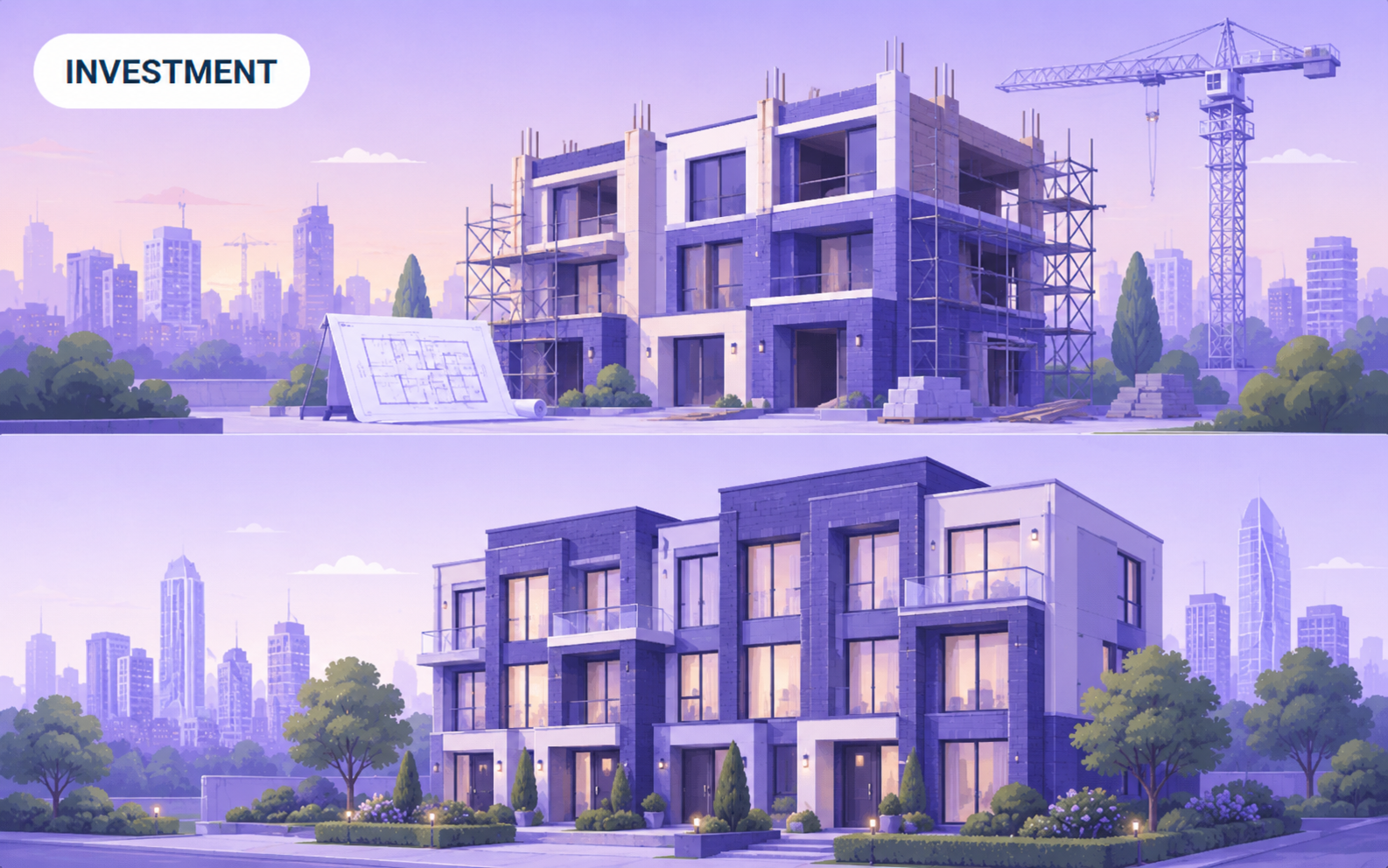
Property investors often face a fundamental choice when comparing opportunities: should you buy a property off-plan, before construction has been completed, or choose a property that is already finished and ready for occupation?
Neither route is automatically better.
Off-plan and completed properties can suit different investors depending on factors such as available capital, investment timescale, financing, desired rental-income timing and appetite for construction or market risk.
An investor who is comfortable waiting for completion may value the payment structure and early access to a development that an off-plan purchase can offer.
Another investor may prefer the greater certainty of seeing a completed property, understanding its immediate rental potential and being able to generate income sooner.
This guide compares the two approaches across the areas that matter most when assessing a UK property investment.
What Is an Off-Plan Property Investment?
Buying property off-plan means agreeing to purchase a property before construction has been completed.
Depending on the stage of the development, the investor may be buying when:
- construction has not yet started
- the development is partially built
- the individual unit is still being completed
The investor typically makes the decision using information such as:
- architectural plans
- floor plans
- computer-generated images
- property specifications
- development information
- local market research
Aspen Woolf covers the wider buying process in its off-plan property investment guide.
The defining feature is that the investor commits before the finished property is physically available to inspect in its completed form.
What Is a Completed Property Investment?
A completed property is already built when the investor purchases it.
Depending on the opportunity, it may be:
- newly completed
- ready for occupation
- already furnished
- ready to be marketed to tenants
- already tenanted in some cases
This gives the buyer greater visibility over the physical asset.
They may be able to inspect the property, assess the finished development and investigate the rental market based on current conditions rather than forecasts several years into the future.
Some completed investments may also operate on a turnkey basis. Aspen Woolf’s guide to turnkey property explains this type of investment in more detail.
Off-Plan vs Completed Property: The Key Differences
The main distinction is timing.
With an off-plan property, there is a period between committing to the purchase and receiving the completed asset.
With a completed property, that construction period has already passed.
That difference affects several areas of the investment, including:
- when rental income can begin
- how financing is arranged
- how much certainty the investor has about the finished asset
- how market conditions may change before ownership begins
- when the investor needs to provide capital
The best way to compare the two routes is to examine each of those factors separately.
1. Purchase Price and Entry Point
One attraction of off-plan property is the opportunity to secure a unit at an earlier stage of a development.
The price will depend on the individual project, unit and market conditions at the time of purchase.
In some developments, different pricing may be offered as sales progress through different construction phases.
That does not mean an off-plan property is automatically cheaper than a completed equivalent.
Investors should compare the asking price against:
- similar completed properties
- local new-build values
- resale property prices
- the development specification
- the wider local market
A completed property may carry a different price because construction risk has already passed and the asset can be inspected immediately.
The important question is not whether a property is off-plan or completed.
It is whether the purchase price is reasonable for the asset and location.
2. When Rental Income Can Begin
This is one of the clearest differences between the two investment routes.
An off-plan property generally cannot generate rental income until construction has been completed and the property is legally and practically ready to let.
If completion is expected in 18 months, for example, the investor may have a substantial period during which no rental income is being generated.
A completed property may offer a much shorter route to letting.
Once the purchase has completed and the property is ready for tenants, the investor can potentially begin marketing it.
This can make completed property more attractive to an investor whose priority is near-term income.
For an investor with a longer time horizon, waiting for an off-plan development to complete may be entirely acceptable.
3. Deposits and Payment Timelines
The payment structure for an off-plan property can differ from that of a conventional completed purchase.
Depending on the development, the investor may be required to pay:
- a reservation fee
- an exchange deposit
- staged payments in some cases
- the remaining balance on completion
The exact structure varies between projects and should be reviewed carefully with an independent solicitor.
A completed property generally follows a more conventional transaction timeline, with the purchase progressing through conveyancing toward completion.
Investors need to understand not simply the total amount required, but when each part of their capital will be needed.
4. Mortgage and Financing Considerations
Financing should be considered early with either type of investment.
Off-plan purchases can introduce an additional timing issue because a mortgage offer obtained when the property is reserved may not remain valid until the eventual completion date.
If construction takes a significant period, the investor may need to revisit financing closer to completion.
Interest rates, lending criteria and the investor’s own circumstances can also change during that period.
With a completed property, financing can usually be considered against an asset that already exists and has a more immediate completion timeline.
However, lender requirements can still depend on factors such as:
- property type
- lease terms
- expected rent
- borrower circumstances
- deposit size
- development characteristics
Investors using finance should obtain appropriate independent mortgage advice before committing to either route.
5. Certainty Over the Finished Property
Completed property offers an obvious advantage: the asset can be seen.
An investor may be able to inspect:
- room dimensions
- natural light
- views
- fixtures and finishes
- communal areas
- the surrounding development
With an off-plan purchase, the decision is made using plans, specifications and development information.
The investor therefore needs to understand exactly what is being promised contractually.
Particular attention should be paid to:
- floor plans
- dimensions
- specification documents
- fixtures and fittings
- development plans
- permitted variations
This does not make off-plan property inherently problematic.
It simply means due diligence relies more heavily on documentation and the credibility of the developer.
6. Potential for Price Movement Before Completion
One reason some investors consider off-plan property is that there may be a period between reservation and completion during which the wider property market changes.
If comparable property values rise during that time, the completed asset may eventually be worth more than the original purchase price.
But the opposite is also possible.
Property values can fall as well as rise.
An investor should therefore avoid building the entire investment case around the assumption that capital growth will occur before completion.
A sensible off-plan purchase should still make sense based on the fundamentals available at the time of investment.
7. Developer and Construction Risk
This is particularly important for off-plan property.
Because the property has not yet been completed, the investor is depending on the developer to deliver the project.
Due diligence can include researching:
- previous developments
- completion history
- company background
- construction partners
- development funding
- warranties
- contractual protections
Investors should also understand what happens if completion is delayed.
Completed property removes much of the construction-stage uncertainty because the development already exists.
However, investors should still investigate build quality, warranties and the developer’s or seller’s history.
8. Rental-Market Timing
Rental-market conditions can change between the point at which an off-plan property is purchased and the point at which it completes.
An area experiencing strong demand today may look different in several years.
Likewise, employment, infrastructure and population trends can strengthen over time.
When assessing an off-plan development, investors should therefore consider:
- current rental demand
- future supply
- planned developments
- employment trends
- transport investment
- tenant demographics
For a completed property, the investor can place greater emphasis on the rental market that exists at the point of purchase.
Current comparable rents may therefore provide a clearer evidence base.
9. Property Management and Readiness
A completed property may allow property management arrangements to begin almost immediately.
If the unit is already furnished and lettable, an agent may be able to start marketing it shortly after completion of the purchase.
For off-plan property, management arrangements may be discussed well in advance, but the practical letting process cannot begin until the property is ready.
In both cases, investors should understand:
- who will manage the property
- management fees
- tenant-finding fees
- maintenance arrangements
- reporting
- whether the management provider can be changed
A property being professionally managed does not remove the need to understand the costs and responsibilities involved.
10. Resale and Exit Considerations
Investors should think about the eventual exit before they buy.
For an off-plan property, questions can include:
- Can the contract be assigned before completion?
- Are there restrictions on resale?
- What happens if personal circumstances change?
- What level of competing supply may exist at completion?
With a completed property, the investor can assess the current resale market more directly.
In either case, consider who may buy the property in future.
A property with potential appeal to both investors and owner-occupiers may have a different resale profile from one aimed at a very narrow buyer market.
Advantages of Buying Off-Plan Property
Depending on the individual development, potential advantages can include:
- access to units before completion
- a longer period before the full purchase balance is required
- choice of units earlier in a development
- new-build specification
- potential price movement during construction
- time to prepare for financing and management
These advantages need to be assessed alongside the risks rather than viewed in isolation.
Potential Drawbacks of Buying Off-Plan
Potential considerations include:
- no immediate rental income
- construction delays
- developer risk
- changing market conditions
- financing uncertainty closer to completion
- limited ability to inspect the finished asset before committing
The longer the period before completion, the more opportunity there is for circumstances to change.
Advantages of Buying a Completed Investment Property
A completed property can offer greater immediacy and certainty.
Potential advantages include:
- the ability to inspect the finished property
- a potentially shorter path to rental income
- current rental evidence
- greater certainty around completion timing
- clearer visibility over the wider development
For investors primarily concerned with generating income sooner, these characteristics can be attractive.
Potential Drawbacks of Completed Property
Completed property also involves trade-offs.
Depending on the opportunity, investors may face:
- less choice of units within a development
- a shorter period in which to organise capital
- different pricing from earlier development phases
- competition from other buyers
If a completed unit has previously been occupied, condition and maintenance history may also require closer assessment.
Which Route May Suit a Long-Term Investor?
An investor with a long time horizon may be more comfortable with the delay associated with an off-plan purchase.
If immediate rental income is not essential, the construction period may fit naturally within the investor’s broader strategy.
However, a long investment horizon alone does not make off-plan property appropriate.
The development, purchase price, location and underlying investment case still need to justify the decision.
Which Route May Suit an Investor Wanting Income Sooner?
If the priority is to begin generating rental income as soon as practical, a completed property may offer the clearer route.
Rather than waiting for construction, the investor can focus on completing the purchase and preparing the property for the rental market.
For some investors, this can also make cash-flow planning easier because the gap between committing capital and receiving potential rental income is shorter.
Questions to Ask Before Buying Off-Plan
Before committing to an off-plan property, consider asking:
- Who is the developer?
- What developments have they completed previously?
- What is the expected completion date?
- What happens if completion is delayed?
- What exactly is included in the property specification?
- What deposit and staged payments are required?
- How is the deposit protected?
- What warranty will apply?
- What are the expected service charges?
- What rental assumptions are being used?
- What happens if mortgage conditions change before completion?
- Are there restrictions on selling or assigning the contract?
Your solicitor should review the legal terms independently before you commit.
Questions to Ask Before Buying a Completed Property
For a completed investment, questions may include:
- Can I inspect the property?
- What is included in the sale?
- Is the property furnished?
- What rent are comparable units currently achieving?
- What are the management fees?
- What are the service charges?
- Is the property currently tenanted?
- What warranty remains?
- Are any defects outstanding?
- How many similar properties are available locally?
- Who is the target tenant?
- What is the likely resale market?
How to Compare Off-Plan and Completed Properties Properly
A useful comparison should go beyond the purchase price.
For each opportunity, consider:
- total capital required
- timing of payments
- expected completion date
- realistic rental income
- gross and net yield
- management costs
- service charges
- financing
- location
- tenant demand
- developer track record
- resale potential
Investors can explore Aspen Woolf’s current UK property investment opportunities to compare different property types, locations and stages of development.
Further educational resources are also available through the Aspen Woolf property investment guides and property buying FAQs.
Off-Plan vs Completed Property: How Should You Decide?
The choice ultimately comes down to what you need from the investment.
An off-plan property may be worth considering if you:
- have a longer investment horizon
- do not require immediate rental income
- are comfortable assessing a property from plans and specifications
- understand the risks associated with construction and changing market conditions
A completed property may be more appropriate if you:
- want greater certainty over the finished asset
- want the potential to generate rental income sooner
- prefer to assess current rather than projected rental-market conditions
- want a more immediate purchase timeline
Neither route removes investment risk.
The strongest decision is the one based on the individual property, development, location, numbers and your own financial objectives.
If you are comparing opportunities, Aspen Woolf provides access to a range of UK investment properties at different stages of development, allowing investors to consider how different opportunities fit their strategy.
The key principle is simple:
Do not choose off-plan because it is off-plan, and do not choose completed property simply because it is ready.
Choose the opportunity whose fundamentals, timing and risk profile make the most sense for your investment objectives.
This article is intended for general information only and does not constitute financial, legal, mortgage or tax advice. Property values and rental income can rise or fall, and investors should obtain appropriate independent professional advice before making an investment decision.