


Should You Invest for Rental Income or Long-Term Growth?
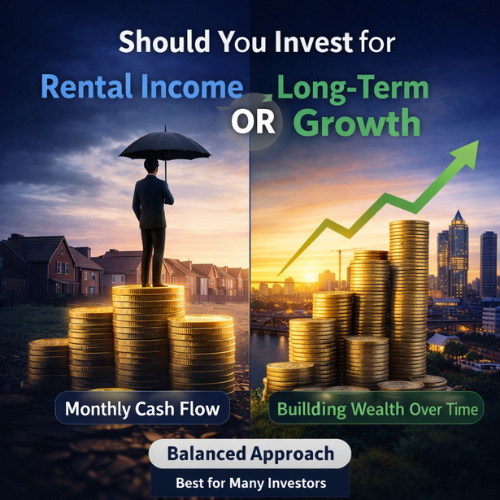
If you need stronger monthly cash flow, invest for rental income. If you are focused on building long-term wealth and can afford to wait, invest for growth. For many UK property investors in 2026, though, the smartest answer is not one extreme or the other. It is a balanced approach. One that gives you a decent income today without sacrificing the long-term strength of the asset. The right strategy depends on your budget, your timeline, your risk appetite, and what you actually want the property to do for you.
Quick Answer: Which Strategy Fits Which Investor?
Income = cash flow first
Growth = equity first
Balance = best for many investors
Your strategy should match your time horizon and risk appetite
That is the cleanest way to think about it.
A lot of investors get stuck because they ask, “Which is better?”
That is the wrong question.
The better question is:
What do I need this investment to do for me?
If you want a property to support itself well and produce stronger monthly returns, income matters more. If you want to build wealth over time and are less worried about immediate rent performance, growth matters more. If you want resilience, flexibility, and fewer regrets, balance often wins.
If you want the deeper version of this conversation, Aspen Woolf’s Average Return on Property Investment UK and UK Property Investment 2025: Key Trends, Insights & Forecast are useful next reads.
When Rental Income Should Come First
There are clear moments when rental income should lead your decision.
Monthly cash flow matters
If your priority is monthly performance, then this is simple.
You should care a lot about income.
That usually means looking closely at:
- realistic rental demand
- sustainable yield
- total running costs
- how quickly can the property be let
This is especially relevant if you are trying to build a property that feels productive from the start, not just promising on paper.
Financing is tighter
If you are using finance, income can matter even more.
Why?
Stronger rent helps support affordability, holding comfort, and overall resilience. It does not remove risk, but it can make the investment easier to carry.
That is why it helps to model real numbers early using Aspen Woolf’s Mortgage Calculator and Stamp Duty Calculator.
You are building an income-led portfolio
Some investors are not trying to maximise future equity on one property.
They are trying to build a portfolio that produces a stronger combined cash flow.
That changes the decision.
For those investors, monthly income and sustainable yield deserve more attention than a pure long-term appreciation story.
You do not want to wait years for the strategy to feel right
Some investors are simply less patient.
That is not a flaw. It is just part of your investor profile.
If you know you want the property to perform sooner rather than later, an income-first strategy may suit you better than buying into a long wait for growth.
When Long-Term Growth Should Come First
Now let’s flip it.
There are also situations where growth should carry more weight.
You are building wealth, not just chasing rent
If your main goal is to increase net worth over time, capital growth matters more.
That means you may be more willing to accept:
- slightly lower headline yield
- a stronger city with tighter entry returns
- a longer hold period
- a market supported by regeneration or supply-demand strength
This is where investors start thinking less like landlords and more like long-term asset allocators.
You are targeting regeneration opportunities
Growth often matters most in places where the wider city story is improving.
That may include:
- infrastructure upgrades
- city-centre regeneration
- job growth
- stronger demand from professionals
- an improving reputation over time
If you are buying into that type of story, the value may not show up fully in year one. But it can matter much more over five or ten years.
You have a longer time horizon
This is key.
Growth rewards patience.
If you are buying with a longer hold period in mind, you can afford to focus more on where the asset may go, not just what it pays you immediately.
You are comfortable accepting a lower yield today
This is the trade-off many investors have to make peace with.
A property in a stronger long-term market may not always give you the most exciting income number on day one.
But that does not make it the wrong investment.
It may simply be doing a different job.
Why Most Investors Should Not Think in Extremes
This is where the conversation usually becomes more realistic.
Because most investors are not purely income-driven.
And they are not purely growth-driven either.
They are somewhere in between.
That is why a balanced approach often makes the most sense.
A balanced strategy usually means:
- you still care about income
- you still care about long-term value
- you do not want to sacrifice one completely for the other
- you want an asset that feels sensible from more than one angle
This is especially important for first-time investors.
Going all-in on high yield can push you into weaker locations.
Going all-in on growth can leave you frustrated by weaker monthly returns.
Balance is often less exciting on paper.
But better in practice.
That is one reason many investors end up focusing on stronger, broader city markets through Aspen Woolf’s Properties rather than chasing the most extreme version of either strategy.
Simple Self-Assessment Table
Before choosing income or growth, use this framework:
Matching the Right Strategy to the Right Investor Goal
| Investor goal | Better fit | What to watch out for |
|---|---|---|
| Stronger monthly cash flow | Income | Chasing headline yield in weak areas |
| Long-term wealth building | Growth | Accepting too little income without enough city strength |
| First investment, want lower regret | Balance | Trying to over-optimise too early |
| Portfolio expansion | Income or Balance | Choosing scale over asset quality |
| Regeneration-led strategy | Growth or Balance | Paying for hype instead of fundamentals |
| Lower patience / shorter hold mindset | Income | Ignoring long-term city quality completely |
| Overseas or remote buying | Balance | Focusing only on yield, not simplicity |
This is the practical filter.
Not “What sounds best?”
But “What fits what I’m actually trying to do?”
Which UK Cities Tend to Align With Each Approach?
Cities do not determine strategy on their own.
But they do influence it.
Income-first logic
Cities like Liverpool Properties and some more income-led regional markets often appeal to investors focused on a stronger rental yield.
That does not mean every property is a strong income investment.
It means those cities are more likely to come up in yield-first conversations, especially when compared with more expensive markets.
If that is your focus, Aspen Woolf’s UK Rental Yields 2025 – Where to Find the Best Buy-to-Let Returns is the right next resource.
Balance and growth logic
Cities like Manchester Properties, Leeds Properties, and Birmingham often come into the conversation when investors want stronger all-round fundamentals.
These cities may offer:
- broader tenant demand
- stronger long-term narratives
- more balanced return profiles
- better resilience than narrower yield plays
But city is only part of the answer
This is the important bit.
A great city does not automatically make a great investment.
And a yield-led city is not automatically wrong.
Your goals still matter more than the headline city name.
That is why Aspen Woolf’s City Guides and Investment Guides are useful. They help you move from broad city ideas into smarter decision-making.
3 Questions to Ask Before You Choose
If you are stuck between income and growth, ask yourself these three questions.
1. Do I need income now?
If the answer is yes, income should carry more weight.
Not all the weight.
But more of it.
2. How long can I realistically hold?
If you can hold for longer, growth becomes more relevant. If you want the strategy to feel useful sooner, income matters more.
3. What kind of city and tenant demand do I trust?
This is often the most revealing question.
Some investors are more comfortable with stronger all-round cities. Others are comfortable pursuing a sharper yield in more selective locations.
Neither is automatically right.
But one is usually more right for you.
Final Take
So, should you invest in rental income or long-term growth in the UK in 2026?
If you need a stronger monthly cash flow, go more income-first.
If you are building long-term wealth and can wait, lean more toward growth.
If you want the most sensible answer for many real-world investors, aim for balance.
Because the right strategy is not the one that sounds best in theory.
It is the one that fits your real goals, your real budget, and your real level of patience.
That is how a property strategy should work.
Not idealised.
Grounded.
If you want help matching strategy to city and asset type, Aspen Woolf’s Contact Us page is the right next step.
FAQ Section
Is rental income better than capital growth?
Not automatically. Rental income is better for investors who want stronger monthly cash flow and more immediate performance. Capital growth is better for investors focused on long-term wealth and equity build-up. For many investors, a balanced strategy is more practical than choosing one extreme.
Can one property deliver both?
Yes, it can. Some properties in stronger cities can offer a mix of decent rental income and long-term growth potential. Usually, though, one side of the return profile will still be stronger than the other. That is why it helps to know what matters most to you before you buy.
Which UK cities suit income-first investors?
Income-first investors often look first at cities like Liverpool and other more yield-oriented regional markets. These cities can offer stronger rental logic, but the exact area, building, and tenant demand still matter. A high yield only works if it is sustainable.
What strategy suits overseas buyers best?
For many overseas buyers, balance is often the best strategy. That is because remote investors usually care about more than yield alone. They also care about city quality, demand resilience, and management simplicity. A slightly lower-yield property in a stronger, more understandable city can often make more sense from abroad.