


Rental Yield vs Capital Growth: How to Choose the Right UK Property Investment Strategy
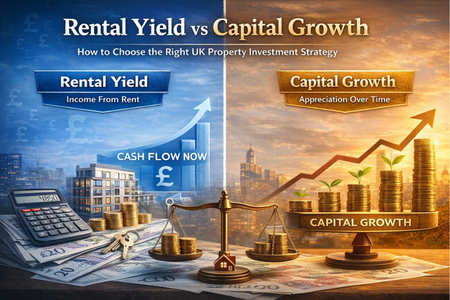
Rental yield is the income return you generate from rent. Capital growth is the increase in the property’s value over time. Both matter. But they do different jobs. Yield helps support cash flow now. Growth helps build wealth later. In 2026, most investors should not obsess over just one. The better move is to understand which one matters more for your goals, your timeline, and your tolerance for risk.
Quick Answer: What Is the Difference?
Rental yield = income return from rent
Capital growth = appreciation in property value
Yield pays you now
Growth pays you later
Smart investors align strategy with goals
That is the cleanest way to think about it.
A lot of confusion comes from treating these as rivals.
They are not.
They are just different return levers.
And the real job is not picking a winner. It is deciding which lever matters more for your strategy.
If you are comparing UK markets more broadly, Aspen Woolf’s UK Property Investment 2025: Key Trends, Insights & Forecast and Average Return on Property Investment UK provide a helpful wider context.
What Is Rental Yield?
Definition: Glossary: Rental Yield
Rental yield is the annual rental income a property generates, expressed as a percentage of the purchase price. It is one of the quickest ways investors compare income potential across different properties or cities.
Simple Definition
In plain English, rental yield answers this question:
How hard is this property’s rent working relative to what I paid for it?
That is why yield matters so much to investors.
It helps you compare a flat in Manchester to an apartment in Liverpool. Or a new-build in Leeds to an older city-centre unit elsewhere.
It gives you a quick lens.
Not the full picture.
But a useful one.
Gross Yield vs Net Yield
This is where investors need to slow down.
Because not all yield is created equal.
Gross yield is the headline number before costs.
Net yield is what remains after real-world costs start biting.
You can explore those supporting concepts in Aspen Woolf’s Glossary: Net Yield and Glossary: Income Yield.
Gross Yield Formula
Gross Yield (%) = (Annual Rent ÷ Purchase Price) × 100
Simple enough.
But here is what gross yield leaves out:
- service charges
- management fees
- maintenance
- void periods
- finance costs
- letting fees
- repairs
- compliance costs
That is why a property with a flashy gross yield can end up feeling average once the dust settles.
And sometimes worse than average.
A 7% gross yield is not automatically better than a 5.8% gross yield if the first property has higher service charges, weaker tenant demand, and more void risk. This is exactly why return analysis should always be paired with wider due diligence and Aspen Woolf’s Risks To Consider.
Why Headline Yield Can Mislead Investors
This is one of the biggest traps in UK property investing.
A lot of investors, especially first-timers, fall in love with the number before they understand the business behind the number.
For example:
- Property A shows 8% gross yield in a weaker area with thinner demand
- Property B shows 6% gross yield in a stronger city-centre location with broader tenant appeal
Which one is better?
You cannot answer that from the headline alone.
Property A might underperform if:
- tenants are harder to secure
- voids are longer
- the building is less desirable
- exit demand is weaker
- maintenance is heavier
Property B may actually be the stronger long-term investment, even with the lower starting number.
So yes, yield matters.
But sustainable yield matters more.
That is the lens smart investors use.
What Is Capital Growth?
Definition: Capital growth is the increase in a property’s value over time. It is one of the main ways investors build equity and long-term wealth, especially in cities or areas supported by regeneration, supply constraints, and strong economic demand.
Capital growth is where patience gets rewarded.
Not always quickly.
Not always evenly.
But often meaningfully over time.
You can support that understanding with Aspen Woolf’s Glossary: Rate of Return and Glossary: Capitalisation Rate, especially if you are building a fuller investment framework rather than just chasing rent.
Simple Definition
If rental yield tells you what the property pays you now, capital growth tells you what the asset may become worth later.
That later value matters because it affects:
- equity position
- refinance potential
- resale upside
- overall wealth creation
This is why some investors care less about whether rent looks amazing on day one.
They are playing a longer game.
Why Growth Is Tied to Time, Scarcity & Infrastructure
Growth is rarely random.
There are usually drivers behind it.
Strong capital growth often depends on factors such as:
- infrastructure improvements
- employment growth
- city-centre regeneration
- transport upgrades
- housing undersupply
- limited supply in desirable areas
Aspen Woolf’s UK Property Investment 2025: Key Trends, Insights & Forecast highlights this wider logic clearly. The point is not that every regeneration zone guarantees price growth. It is that property values are usually strongest where economic fundamentals support rising demand over time.
Why Growth Areas Aren’t Always High-Yield Areas
This is where many investors get frustrated.
They assume the best growth cities should also have the best yields.
Sometimes that happens. Often it does not.
Why?
Stronger-growth markets are frequently more expensive to enter. That higher entry pricing can compress yield even when the long-term case is very good.
So a city can be:
- excellent for future appreciation
- less exciting on day-one income
And that is perfectly normal.
This is why strategy matters more than chasing whichever number looks best in isolation.
Why Many Investors Get This Wrong
A lot of investors do not fail because they choose yield or growth.
They fail because they never decided which one they were really buying for.
Here is how that usually shows up.
Chasing the highest yield blindly
This is the classic trap.
A property looks attractive on paper because the rent-to-price ratio is high. But the area is weak, the building is average, tenant appeal is narrow, and resale demand is poor.
That is not smart income investing.
That is yield-chasing.
Chasing hype growth areas
The opposite mistake is just as common.
An investor hears that a city is booming, regeneration is coming, and values are rising. So they overpay for a pretty story without checking whether the exact asset still makes sense.
A strong city does not automatically make every unit a strong investment.
Ignoring the holding horizon
Yield and growth are deeply tied to time.
If you need performance quickly, growth-only logic can feel painfully slow.
If you are building for the long term, obsessing over month-one yield can cause you to miss stronger compounding opportunities.
Not knowing if they want income or equity
This is the real issue underneath everything.
A lot of investor confusion disappears the moment they answer one simple question:
Do I want this property to pay me now, or make me wealthier later?
Sometimes the answer is both.
But even then, one usually matters more.
When Rental Yield Should Matter More
There are clear scenarios where yield deserves more weight in your decision.
Monthly cash flow focus
If your main goal is income, yield matters.
That sounds obvious. But it needs saying because some investors talk themselves into growth-led assets even when what they really want is monthly performance.
If your thinking is:
- I want the property to support itself well
- I want higher near-term income
- I care about cash flow visibility
then yield should be a major part of the decision.
Income-led portfolio builders
Some portfolio builders are not trying to maximise one asset’s future value.
They are trying to build a wider base of income-producing assets.
That changes the equation.
In that case, a city or property with a stronger sustainable yield may matter more than one with the loudest growth narrative.
Tighter financing constraints
If finance is part of the picture, yield can matter even more.
A stronger rental position can improve comfort around affordability, holding costs, and resilience.
This is where Aspen Woolf’s Mortgage Calculator becomes useful. Because the return strategy is not just about ambition. It is also about what works in the real world.
When Capital Growth Should Matter More
Now let’s look at the other side.
Because some investors care less about what the property does next month and more about what it becomes over the next five or ten years.
That is where growth starts to dominate the conversation.
Long-term wealth builders
If you plan to build equity over time, capital growth matters a lot.
This is especially true if you are:
- thinking in decades rather than months
- prioritising future refinance flexibility
- building net worth, not just income
Regeneration zone investors
Growth-led investors often focus on places where there is a wider city story supporting future value.
That may include:
- infrastructure investment
- city-centre regeneration
- employment growth
- improving desirability
- long-term undersupply
Aspen Woolf’s Where Are the Best UK Cities to Invest in Property in 2025? is useful here because it frames how different cities appeal to different return profiles rather than pretending every strong city wins in the same way.
Compound-return mindset
Some investors understand that modest income plus strong appreciation over time can be more powerful than chasing the highest rent percentage now.
That does not mean growth always wins.
It means wealth compounds differently depending on what you are trying to build.
If you care about long-term wealth, not just rent, this is the section that should matter most to you.
Which UK Cities Tend to Suit Each Strategy?
This is where city choice becomes strategic rather than emotional.
Stronger Yield Associations
Certain cities or areas are more often associated with yield-first investing.
That usually includes:
- Liverpool
- Bradford
- Sunderland
- selected Leeds areas
If you are exploring income-led opportunities, Liverpool Properties and parts of Leeds Properties may naturally come into the conversation.
Aspen Woolf’s UK Rental Yields 2025 – Where to Find the Best Buy-to-Let Returns is also relevant because it frames where stronger buy-to-let returns tend to cluster.
Stronger Balanced Growth Associations
Other cities lean more toward balanced performance rather than pure headline yield.
That usually includes:
- Manchester
- Leeds
- Birmingham
Manchester Properties often appeals to investors who want broad demand, a strong city profile, and longer-term confidence rather than just the highest income number today.
Leeds sits in an interesting middle ground here. It can appear in both conversations, which is one reason it attracts so much investor attention.
Why City Still Depends on Investor Strategy
This is the crucial point.
A city does not win in isolation.
It only wins relative to your strategy.
That means:
- a high-yield city is not automatically right if you value stronger long-term appreciation
- a strong growth city is not automatically right if you need income now
- a balanced city can often be the smarter choice than either extreme
Headlines do not build portfolios.
Fit does.
The Balanced Strategy: Why Most Investors Shouldn’t Choose Extremes
This is the part many investors need to hear.
You do not always have to choose between yield and growth, as if it is one or the other.
In fact, most investors probably should not.
Because extremes create problems.
All-yield thinking can lead to weak assets in weak areas.
All-growth thinking can lead to poor cash flow and long periods of frustration.
A more balanced approach often works better.
That may mean:
- choosing one property for income and another for appreciation
- targeting cities that offer both reasonably well
- accepting slightly lower headline yield in exchange for stronger location quality
- building a portfolio that can perform in more than one way
Aspen Woolf’s live Properties can be viewed through exactly that lens: not “Which listing looks highest on paper?” but “Which asset best fits what I am trying to build?”
A Practical Framework for Judging Any Investment
This is the framework section investors can actually use.
Because once you stop arguing about yield vs growth in theory, you need a way to judge real opportunities.
Want help applying this framework? Speak to an advisor via Contact Us.
And when you are modelling the numbers, do not guess. Use the Mortgage Calculator and Stamp Duty Calculator so your strategy is grounded in reality.
Worked Examples
Sometimes the clearest way to explain this is to walk through investor types.
Investor A: Income-First Buyer
This investor wants stronger monthly performance.
They are not against growth.
But cash flow matters more.
They may prioritise:
- stronger sustainable yield
- lower entry pricing
- cities with stronger rent-to-price ratios
- assets that can be used quickly
This investor might naturally lean toward Liverpool or selected Leeds stock rather than automatically chasing the biggest city brand.
Investor B: Long-Term Growth Investor
This investor is thinking further ahead.
They care about:
- future value uplift
- stronger city fundamentals
- long-term desirability
- economic drivers and scarcity
This investor may be more comfortable sacrificing some yield for a stronger long-term city story, possibly in Manchester or selected Leeds regeneration areas.
Investor C: Overseas Buyer Seeking Balance
This investor wants something practical.
Not the highest yield.
Not the boldest growth story.
Something balanced and understandable from a distance.
They may value:
- clear city fundamentals
- manageable asset type
- broad tenant demand
- strong location quality
- easier decision-making remotely
That is why overseas buyers often gravitate toward balanced cities and straightforward stock. Aspen Woolf’s City Guides and Investment Guides are especially useful for this kind of investor.
What Risks Should Investors Factor In?
This is where good strategy becomes honest strategy.
Because both yield and growth can mislead you if you do not understand the risks underneath them.
Yield traps
A high yield is meaningless if it depends on weak demand, poor stock quality, or unrealistic rent assumptions.
Overpaying for growth narratives
A city can be strong. A development can be well marketed. That still does not mean the entry price is smart.
Weak tenant demand
If tenants do not want the unit, the strategy falls apart quickly. This matters whether your focus is income or long-term value.
Leasehold and service charge erosion
Some city-centre properties can look fine at gross yield level and much less attractive once service charges and leasehold realities start cutting into returns.
Holding horizon mismatch
This is one of the most common investor mistakes.
Buying a growth-led asset when you need short-term performance.
Or buying a yield-led property when your real aim is long-term equity growth.
That mismatch creates frustration fast.
Aspen Woolf’s Risks To Consider is worth treating as part of the decision process, not an afterthought.
How Aspen Woolf Clients Can Use This Framework
The most useful thing about this framework is that it helps investors stop asking vague questions.
Instead of:
- “Is this a good property?”
- “Is yield better than growth?”
- “Is this city hot right now?”
You start asking better questions:
- what is this property designed to do for me?
- does it match my timeline?
- is the yield sustainable?
- do real fundamentals back the growth story?
- does this asset fit my wider portfolio direction?
That is a much stronger way to invest.
And it is also how Aspen Woolf clients should think about opportunity selection. Not every development suits every investor. Not every city should be approached the same way. Strategy first. Property second.
Before making a move, run the numbers with the Stamp Duty Calculator and Mortgage Calculator, then use Contact Us if you want a more tailored discussion.
Final Verdict
Yield pays you now.
Growth pays you later.
Smart investors know which one they need most.
That is the real answer.
Not that one is universally better.
Not that the highest percentage wins.
And not that every strong city should be judged the same way.
If you want a monthly income, yield deserves more weight.
If you want long-term wealth creation, growth matters more.
If you want resilience, a balanced strategy often makes the most sense.
And if you are still unsure, that is not a problem. It just means you need the right framework.
For a tailored shortlist based on your goals, timeline, and budget, contact Aspen Woolf via Contact Us.
FAQ’s
Is rental yield more important than capital growth?
Neither is automatically more important. Rental yield matters more for income-focused investors who care about cash flow now. Capital growth matters more for investors prioritising long-term wealth and equity build-up. Most investors should decide based on what they want the property to do, not which metric sounds more impressive.
What is a good rental yield in the UK?
A good rental yield depends on the city, asset type, cost structure, and risk level. In general, investors should be more focused on sustainable yield than just the highest headline number. A lower yield in a stronger area can often be better than a higher yield in a weaker one.
Can one property deliver both yield and growth?
Yes, it can. Some cities and assets offer a reasonable balance of both, which is often why markets like Manchester and Leeds attract so much interest. But usually one side of the return profile will still be stronger than the other, so it is important to know what matters most to you.
Which cities are better for capital growth?
Cities with stronger regeneration, employment growth, and infrastructure support often have better long-term capital growth potential. Manchester and Leeds are frequently discussed in that context, while Birmingham also comes up in balanced growth conversations. But city choice should always be filtered through property type, location quality, and your own strategy.
Should first-time investors prioritise yield?
Often, yes, but not blindly. First-time investors usually benefit from understanding how well a property supports itself and how realistic the rental performance is. That said, first-time buyers should not chase high yield at the expense of location quality, demand, or exit potential. A balanced asset in a stronger city can be a smarter first move than a flashy headline yield.